

HeFH Adult Patient Recruitment | EPI-001 Injection IIT Clinical Study (Investigator-Initiated)
Dear fellow patients with heterozygous familial hypercholesterolemia (HeFH),
Hello everyone!
Recently, a"Single-center, open-label, single-arm, dose-escalation and dose-expansion investigator-initiated trial (IIT) evaluating the tolerability, safety, pharmacokinetic characteristics, and preliminary efficacy of EPI-001 injection in the treatment of heterozygous familial hypercholesterolemia (HeFH)"has initiated patient recruitment.
This clinical study is sponsored by Yijie Like (Shanghai) Biotechnology Co., Ltd., and aims to evaluate the tolerability, safety, pharmacokinetic characteristics, and preliminary efficacy of EPI-001 injection in adult patients with relapsed or refractory heterozygous familial hypercholesterolemia (HeFH).
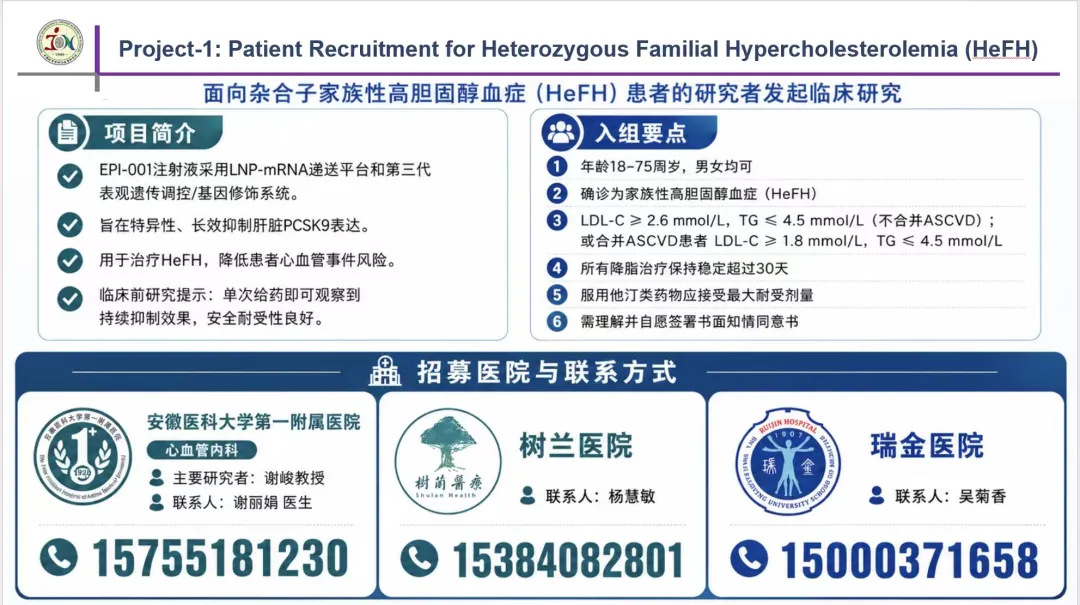
To help you better understand the specific details of this clinical trial, we have organized the key information as follows:
EPI-001 injection is an innovative drug that targets PCSK9 to reduce low-density lipoprotein cholesterol (LDL-C).
Unlike commonly used monoclonal antibodies, siRNA, and gene editing, it works through epigenetic regulation and does not alter DNA.
Its advantage lies in the potential to achieve longer-lasting and stable LDL-C reduction with a single injection, with efficacy potentially approaching that of current PCSK9 monoclonal antibodies administered every few weeks, or siRNA administered every 6 months.
1. Male or female patients aged 18 to 75 years (inclusive of boundary values), diagnosed with HeFH.
2. Score > 8 according to the FH diagnostic criteria.
3.For patients without atherosclerotic cardiovascular disease (ASCVD): LDL-C level ≥ 2.6 mmol/L (100 mg/dL) and TG ≤ 4.5 mmol/L (400 mg/dL); or for patients with ASCVD: LDL-C level ≥ 1.8 mmol/L (70 mg/dL) and TG ≤ 4.5 mmol/L (400 mg/dL).
4. All lipid-lowering therapies (e.g., but not limited to statins and/or ezetimibe) must remain stable (stable dose and no medication changes) for ≥ 30 days prior to screening.
5. Subjects not currently receiving statin therapy must have evidence-based documentation of intolerance to all doses of at least 2 different statins (or meet the nationally or internationally recognized definition of complete statin intolerance).
6. Subjects taking statins should receive the maximum tolerated dose or the maximum recommended dose per the prescribing information. The maximum tolerated dose is defined as the highest dose of a statin that can be taken regularly without unacceptable adverse events.
7. Subjects (males and females of childbearing potential) and their sexual partners must be willing to have no pregnancy plans from screening to 6 months after the last dose of the study drug, voluntarily adopt effective contraceptive measures, and have no plans for sperm or egg donation.
8. Subjects must be able to understand the procedures and methods of this clinical trial, agree to participate in the study, voluntarily sign the informed consent form, and be judged by the investigator as capable of complying with the protocol requirements.
1. Known allergy to EPI-001T, any component of the formulation, or other drugs of the same class;
2. Subjects diagnosed with any of the following diseases: homozygous familial hypercholesterolemia, double heterozygous familial hypercholesterolemia, compound heterozygous familial hypercholesterolemia, heart failure, uncontrolled diabetes mellitus (fasting blood glucose ≥ 10 mmol/L or glycosylated hemoglobin ≥ 7.0%), severe hypertension (systolic blood pressure ≥ 180 mmHg and/or diastolic blood pressure ≥ 110 mmHg), chronic hepatitis or liver cirrhosis, or any uncontrolled or severe disease;
3. Known concomitant diseases that may cause secondary hyperlipidemia, including hypothyroidism, nephrotic syndrome, cholestatic liver failure, etc.;
4. Any malignancy within 5 years prior to screening or currently present, except for those completely cured such as basal cell carcinoma, squamous cell carcinoma of the skin, melanoma in situ, papillary thyroid carcinoma, and cervical carcinoma in situ;
5. Major adverse cardiovascular or cerebrovascular events within 3 months prior to randomization, such as myocardial infarction, unstable angina, percutaneous coronary intervention (PCI), coronary artery bypass grafting (CABG), stroke, severe deep vein thrombosis or pulmonary embolism, or severe arrhythmia not controlled by medication;
6. Treatment with monoclonal antibodies inhibiting PCSK9 within 45 days prior to the first dose; use of any over-the-counter medications affecting lipid metabolism within 14 days prior to the first dose (e.g., traditional Chinese medicine/patent medicine, vitamins, fish oil (>1000 mg/d), medications or health products containing red yeast rice, etc.);
7. Lipoprotein plasma exchange therapy within 12 months prior to randomization;
8. Subjects who have previously undergone organ transplantation, gene therapy, or have participated in clinical trials of PCSK9 gene therapy (ASO and small nucleic acid drugs);
9. Participation in another clinical study of an investigational non-biologic (administered within the past 30 days or 5 half-lives, whichever is longer) or investigational biologic (monoclonal or polyclonal antibody) (within the past 4 months or 5 half-lives, whichever is longer) prior to screening;
10. Pregnant or lactating women, or those with a positive blood pregnancy test;
11. Clinically significant abnormal echocardiogram findings at screening that, in the investigator's judgment, make the subject unsuitable for this study, such as LVEF < 50%;
12. Laboratory abnormalities at screening or before the first dose of the study drug that persist despite treatment (based on the normal values of the study center): alanine aminotransferase (ALT) or aspartate aminotransferase (AST) > upper limit of normal (ULN); creatine kinase > 3×ULN; thyroid-stimulating hormone (TSH) > 1.5×ULN or < LLN; total bilirubin (TBIL) > 1.5×ULN; estimated glomerular filtration rate ≤ 70 mL/min; BNP > 100 ng/L; platelet count (PLT) ≤ 100×10⁹/L, hemoglobin (HGB) ≤ 90 g/dL; plasma prothrombin time (PT), activated partial thromboplastin time (APTT), or international normalized ratio (PTINR) > 1.5×ULN;
13. Positive test results at screening for hepatitis C antibody, hepatitis B surface antigen, hepatitis B core antibody, syphilis antibody, or human immunodeficiency virus antibody;
14. Other conditions that, in the investigator's judgment, make the subject unsuitable for participation in this study.
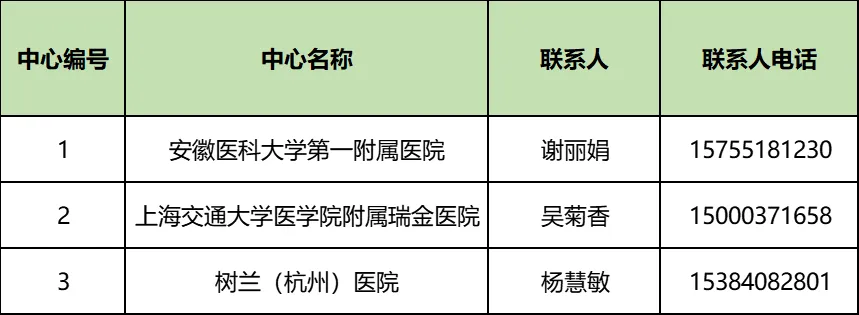

If you or your family members are interested in participating in this clinical study, please contact the study center listed in the table above for detailed consultation.
